


Flying and your skin: what actually happens in the cabin
You land, you look in the mirror, and your face is dull, tight and somehow both dry and shiny. It is the one skin situation almost everybody recognises and almost nobody prepares for properly.
The cause is a single number.
Cabin air is extraordinarily dry
Relative humidity in an aircraft cabin typically sits between 10 and 20 per cent. A comfortable room is 40 to 60. On a long-haul flight you are spending eight hours or more in air far drier than anything you normally encounter.
The reason is simple: the air is drawn in from outside at altitude, where there is almost no moisture in it. Humidifying it would add weight and cause condensation problems, so it stays dry.
What that does to your skin is straightforward. Water evaporates from the surface faster than your barrier can replace it. Skin feels tight, makeup starts to cling to dry patches, and oily skin often overproduces sebum in response, which is the dry-and-shiny combination people describe on landing.
The mistake most people make
The instinct is to pack a hydrating serum and reapply it during the flight. On a plane, that can make things worse.
Hyaluronic acid and glycerin are humectants: they attract water. In very dry air there is nothing to attract from the outside, so they pull moisture up from deeper in your skin, where it evaporates. A watery serum, on its own, at 15 per cent humidity, is the exact scenario where a humectant works against you. The article on hyaluronic acid covers the mechanism.
The fix is not to skip the serum but to always seal it. Something with lipids on top, so the water it draws in stays put.
What to do, and when
Before you board
- Cleanse and moisturise properly at the airport, or before you leave. Start the flight with an intact barrier rather than a bare face.
- Skip makeup on long flights if you can. It has nothing to do with your skin breathing, which is not a thing, and everything to do with not needing to remove it in an aircraft bathroom.
- Do not start anything new. A flight is a bad time to discover you react to something. Save the new product for when you are home.
- No acids or retinol the night before. A freshly exfoliated barrier plus cabin air is a rough combination.
During the flight
Once, halfway, is enough for most people. Damp your face with water first, then serum, then something richer on top. The order matters more than the number of steps.
If you have a window seat on a daytime flight, keep the shade down or wear SPF. Aircraft windows block UVB but let a good deal of UVA through, and at altitude there is more of it. It is the same reason altitude matters outdoors.
After landing
Cleanse to get the day off, then focus on repair for a night or two. Lipids rather than actives. If your skin feels tight or reactive, treat it as a temporarily compromised barrier and give it a couple of quiet days.
Why people break out after travelling
Usually not the flight itself. It is the combination around it: sleeping badly, a different climate, unfamiliar water, hotel towels, touching your face more, and often a disrupted routine. Skin that clogs easily reacts to that stack rather than to the cabin.
The practical answer is to keep your routine as close to normal as you can while travelling, rather than switching to hotel miniatures for a week.
What to actually pack
Three things cover most trips: a gentle cleanser, something hydrating with lipids in it, and your SPF. Everything else is optional.
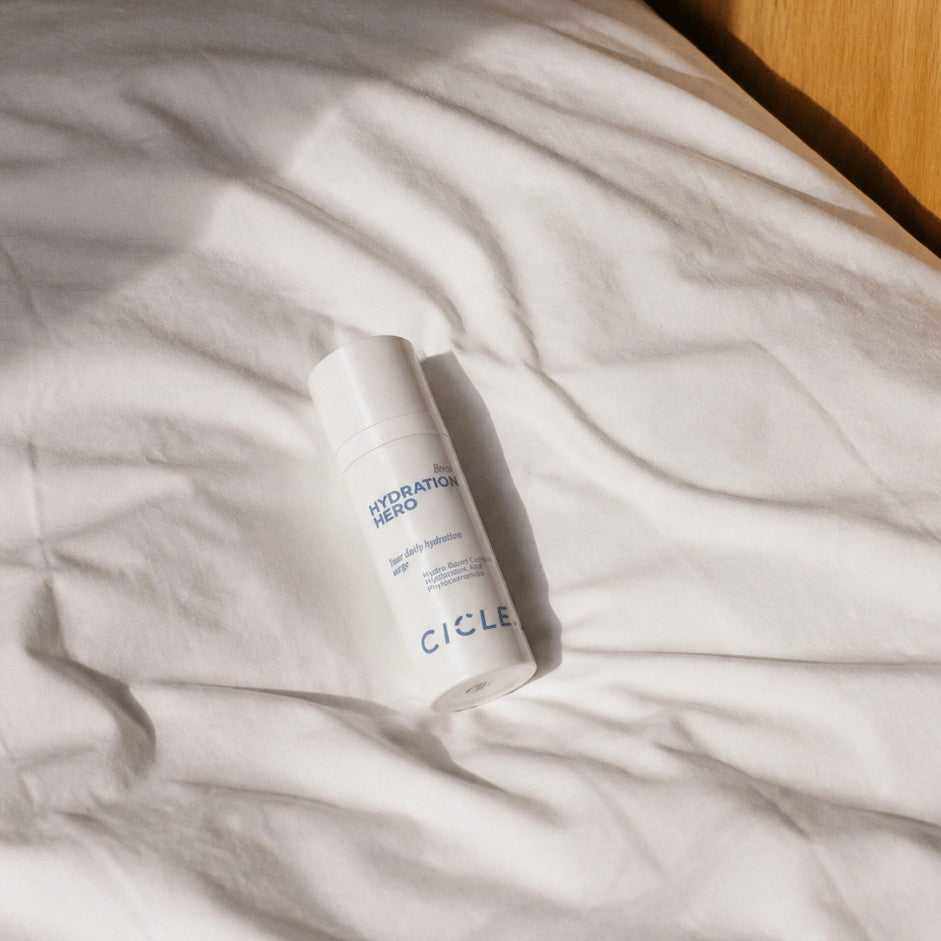
Hydration Hero is the one worth having in hand luggage, because it combines the humectants with Ceramide NP and squalane that hold what they attract. In a 30 ml pump it clears the liquid rules, and being airless means it survives pressure changes without leaking.
For the evening after landing, Dewy Dream as the sealing step. And Daily Defense for the window seat and wherever you have landed.
Frequently asked questions
Does drinking water help my skin on a flight?
Drink it for your general wellbeing. Your skin loses water to the air from the outside, and drinking more does not close that gap. What you put on the surface does.
Are sheet masks on planes a good idea?
They work while they are on, mainly by trapping moisture against the skin. Once you take it off, whatever it added evaporates unless you seal it. If you use one, follow it with a moisturiser.
Does a facial mist help?
On its own it can make things worse, because the water evaporates and takes a little more with it. A mist followed immediately by a moisturiser is fine.
What about very long flights?
Same approach, applied twice rather than once. The frequency matters less than always sealing.
Sources
- World Health Organization, Guide to hygiene and sanitation in aviation, cabin environment.
- Fluhr JW, Darlenski R, Surber C, Glycerol and the skin, British Journal of Dermatology, 2008.

Share your thoughts
We'd love to hear from you! Leave a comment below and join the conversation.
Please note that all comments are reviewed before being published.