


Vitamin C in skincare: which percentage actually tells you something?
Vitamin C is the ingredient people write about most and disagree about hardest. One source says you need at least fifteen per cent, another that your serum is brown and useless after three months. Both are half right, because they are describing different kinds of vitamin C.
Below: what it does, why those percentages cannot be compared, and how to tell when yours has stopped working.
What it does for your skin
- It catches free radicals. UV and pollution create unstable molecules that damage skin cells in a chain reaction. Vitamin C stops that chain.
- Your skin needs it to build collagen. Without enough of it, the collagen your body makes is weaker.
- It fades dark spots. It slows the enzyme that overproduces pigment in one place. It bleaches nothing and it does not remove existing pigment, which is why it works gradually.
The percentage question
The advice to look for "between 10 and 20 per cent" is not made up, but it describes one specific kind: pure L-ascorbic acid in a low-pH watery serum. In that setup you need a lot, because much of the vitamin C has already broken down before you apply it.
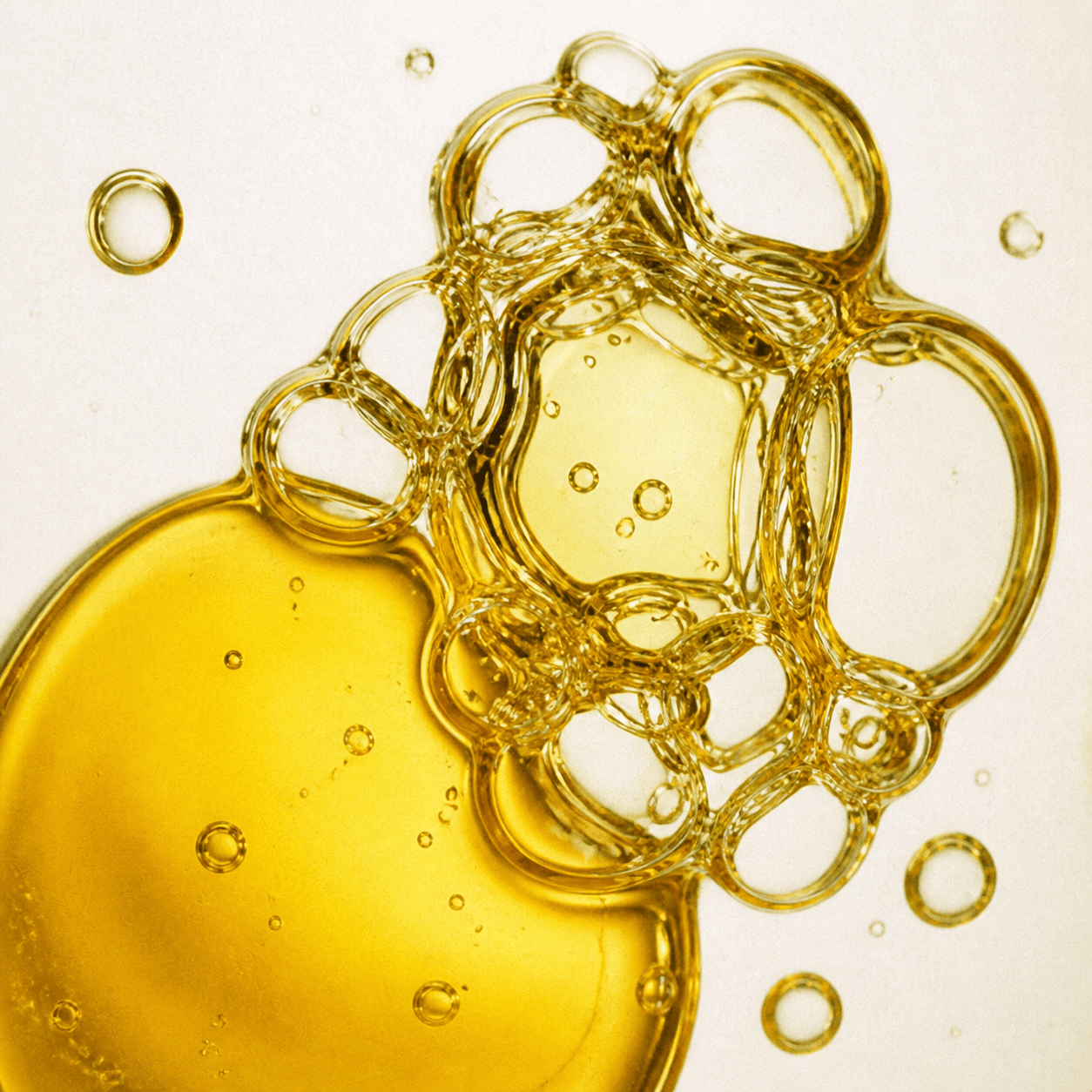
That is the real problem with L-ascorbic acid: it is unstable. Light, air and heat oxidise it. You can watch it happen, because the serum turns yellow first and then orange-brown.
So stabilised versions exist, where the vitamin C is protected rather than overdosed. That is what we use: ascorbic acid stabilised with gold particles, which keeps it usable in a water-based formula where free ascorbic acid would degrade fast.
What this means for you: you cannot compare those percentages. Fifteen per cent unstable vitamin C and a lower-dosed stabilised one are different design choices, not a stronger and a weaker version of the same thing. A high number only tells you something if you also know how much of it leaves the bottle alive.
Why it rarely comes alone
Vitamin C, vitamin E and ferulic acid work as a set: vitamin C recharges vitamin E, and ferulic acid keeps both stable for longer. A 2005 study in the Journal of Investigative Dermatology found that adding ferulic acid to vitamins C and E doubles their protection against sun damage. You will find claims online of eight times more; that is not in the paper.
One thing to be clear about: this is not sun protection. Vitamin C does not block UV and does not replace your SPF. It clears up the damage that happens anyway.
How to use it
- In the morning, when your skin is actually exposed to light and air.
- On clean, dry skin. One or two pumps for face and neck. More does not give you more.
- Then moisturiser, then SPF.
Do not put it in the same layer as retinol or a strong exfoliating acid. Vitamin C in the morning, those in the evening, and each gets room to work.
How to tell it has expired
Colour is your best indicator. Clear to pale yellow is fine. Clearly orange or brown means oxidised, and at that point it can irritate rather than help. Keep it out of the sun and choose packaging that keeps air out, because an open dropper bottle in a bright bathroom is the fastest way to waste it.
What ours is
Protective Power is a 30 ml morning serum with gold-stabilised ascorbic acid, ferulic acid and vitamin E. The same combination the research describes, in a form that does not oxidise within weeks. The packaging is airless, which matters for an ingredient this fragile.
It goes before your moisturiser and Daily Defense, not instead of your SPF.
Frequently asked questions
How long before I see something?
A fresher, more even tone within a few weeks. Dark spots and firmness need twelve weeks or more. That is simply the speed at which skin renews itself.
Can I combine it with niacinamide?
Yes. The idea that they cancel each other out comes from 1950s lab work, not from finished products.
Does vitamin C from food do the same?
Not for your skin specifically. What you eat is shared out across all your organs, and skin is not first in line. Applying it directly puts a far higher concentration where you want it.
Should it sting?
Low-pH formulas with free ascorbic acid often tingle a little. Stabilised ones usually do not. Persistent burning is a reason to stop either way.
My skin is sensitive. Can I still use it?
Start every other morning and see how your skin responds. Brief tingling is not unusual; lasting redness is.
Sources
- Lin FH et al., Ferulic acid stabilizes a solution of vitamins C and E and doubles its photoprotection of skin, Journal of Investigative Dermatology, 2005.
- Pullar JM, Carr AC, Vissers MCM, The roles of vitamin C in skin health, Nutrients, 2017.

Share your thoughts
We'd love to hear from you! Leave a comment below and join the conversation.
Please note that all comments are reviewed before being published.